The letter comes from the state, and it changes your week. Your town crossed some line, maybe in population, maybe in how close you sit to a bigger city, and now you hold an MS4 permit. MS4 stands for Municipal Separate Storm Sewer System. In plain terms, it means the pipes and ditches and grates that carry rainwater off your streets are now a regulated system, and the state expects you to manage it like one.
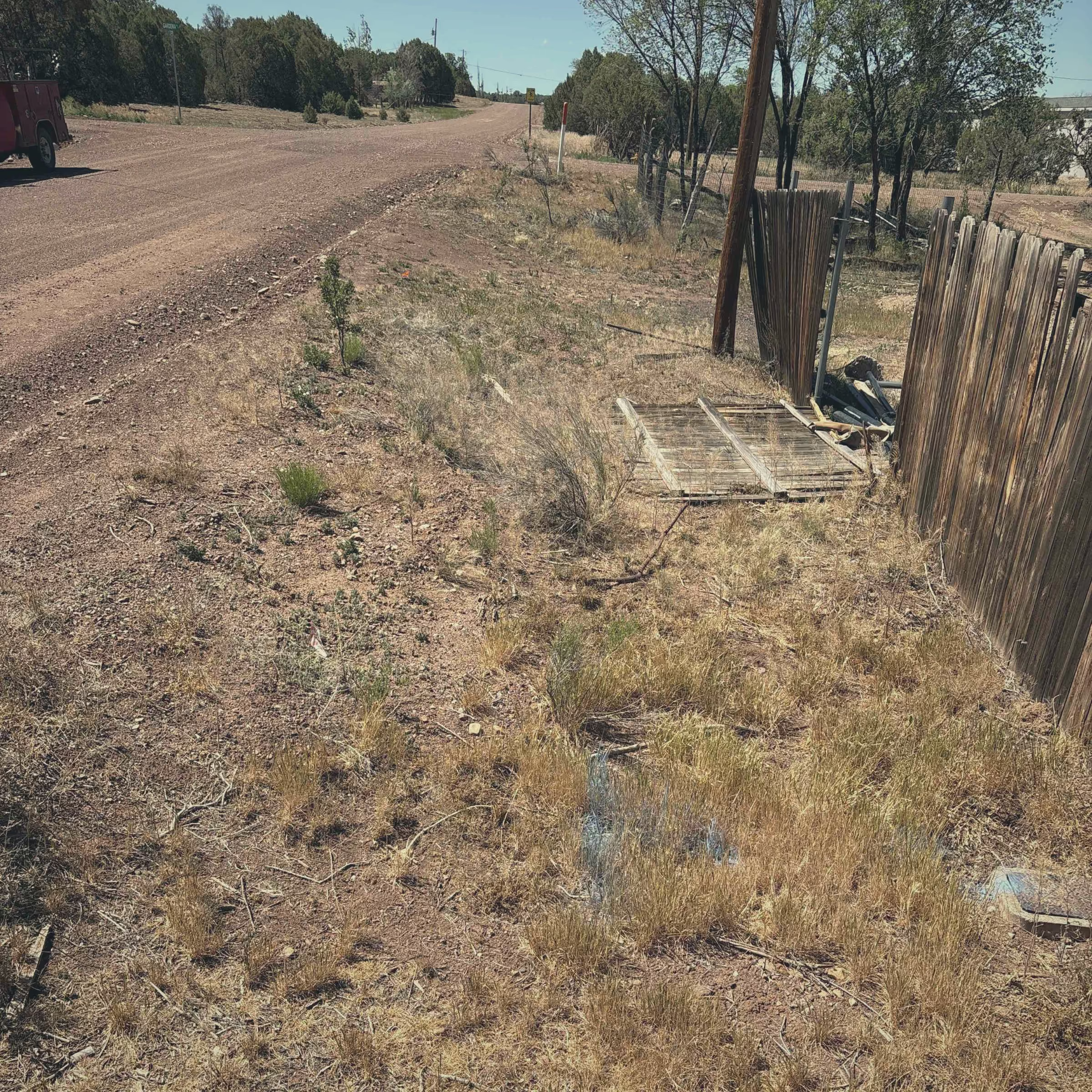
So you go looking for the map. And there isn't one. The water side has a map, sort of, even if half of it lives in a binder or in the old operator's head. The stormwater side has nothing. Nobody ever drew the catch basins. Nobody logged where the pipes run or where they let out into the creek. The grates in the street have been there for forty years and not one of them is written down anywhere.
That is the spot a lot of small towns are in. You did not ask for a stormwater program. You got one in the mail. And the first thing the permit wants is proof that you know your own system, which means you need a map of it before you can do anything else.
This is a guide to getting that done without an engineering firm on retainer and without a GIS degree. Map the stormwater system, log the inspections the permit asks for, and keep the records where you can pull them. Here is how a one or two person crew actually does it.
What an MS4 permit asks a small town to do
An MS4 permit is the stormwater piece of the Clean Water Act, run through the NPDES program. The short version: rainwater that runs off your streets and into a ditch or a pipe and out to a creek is a discharge, and the state regulates it. Your permit lays out a set of control measures you have to run and document, and then it asks you to report on them on a schedule.
The exact control measures and how often you report are spelled out in your permit, and they vary by state and by the size of your system. Read your own permit, and if you are not sure when something is due, ask your state contact. [VERIFY: MS4 minimum control measures and reporting cadence for the specific state permit].
But underneath the legal language, most of what the permit wants from a small utility comes down to the same handful of things. Know where your stormwater assets are. Look at them on some regular basis. Write down what you found. And be able to hand the state a record when they ask. Every one of those starts with a map, because you cannot inspect what you have not located, and you cannot prove an inspection that is not tied to a place.
The good news is that the work is not complicated. It is just work that nobody has done yet. And the part that scares people, the documentation, gets a lot smaller once the map exists.
How to map your stormwater system
Mapping your stormwater system means putting every piece of it on a map you can pull up later. You walk it, you drop a point for each asset, and you write down what it is. The pieces of a stormwater system are not hard to spot once you know what you are looking for.
Catch basins and inlets. These are the grates and curb openings in the street that take the runoff. Walk your streets, drop a point on each one, snap a photo, and note the condition. Is the grate broken. Is it full of leaves and grit. You will be back to clean these, so the location and the photo matter.
Conveyance pipes and ditches. This is what moves the water from the inlets to wherever it goes. Some of it is buried pipe and some of it is open ditch. Map what you can see and trace what you know. The old as-builts, if you have any, help here. So does the operator who remembers where the line runs.
Outfalls. These are the spots where your system lets out into a creek, a pond, or a drainage way. Outfalls matter more than almost anything else on the stormwater side, because this is where the permit cares most about what is coming out of your pipes. Walk the creek banks, find every pipe that discharges, and map it. Photograph each one.
Detention and retention basins. These are the ponds and basins that hold runoff back so it does not flood downstream. Map the footprint, note the outlet structure, and flag anything that needs mowing or repair.
You do not need fancy gear for this. A phone in the field is enough to drop a point on a satellite picture and attach a photo. If you want the deeper version of how a small utility moves from paper to a working digital map, we wrote that up in From Paper Maps to Digital GIS. The same approach works for stormwater. The difference is you are usually starting from nothing instead of from an old binder, which is oddly easier. There is no bad map to argue with. You just go build the right one.
Map it once, in spare hours over a few weeks, and you have the foundation the whole permit rests on. For a fuller look at what utility mapping involves, our guide to GIS mapping covers the basics without the enterprise software pitch.
How to log catch basin and outfall inspections
Logging an inspection means recording what you looked at, when, what you found, and proof you were there. On the stormwater side the two inspections you will do most are outfall checks and catch basin cleaning, and both get a lot easier when they are tied to the spot on the map.
Here is what that looks like in the field. You pull up the map, you tap the outfall you are standing at, and you log the check right there. Dry weather flow, yes or no. Color. Smell. Anything floating that should not be. Take a photo. Move to the next one. By the time you have walked your outfalls, the record is already done. You did not carry a clipboard and you did not retype anything at the office that night.
Catch basin cleaning works the same way. You tap the basin, note that you cleaned it, log how much grit came out if your permit wants that, snap a before and after, and move on. Over a season you build a record of every basin, when it was last cleaned, and how fast it fills. That last part is useful beyond the permit. The basins that fill fastest tell you where your problems are.
The photo is the part that does the heavy lifting. An operator at Veolia put it as plainly as anyone could: "Take a picture, add it. Boom. Here's proof." When the state asks whether you actually inspected that outfall in the third quarter, you are not digging through a drawer. You have the photo, the date, and the spot on the map, all in one record.
A stormwater inspection checklist does not have to be a paper form that gets lost. It can be the set of fields you fill in on your phone every time you tap an asset, so the checklist and the record are the same thing.
Pulling the documentation the permit asks for
The reason to map and log all of this is the day the report is due. When the state wants your stormwater documentation, you want it to be a two minute job, not a two week fire drill.
That is the difference between records in one place and records scattered across a truck, a filing cabinet, and somebody's memory. If every inspection is tied to an asset on the map, pulling a year of outfall checks or a season of catch basin cleaning is a matter of filtering and exporting. You hand the state a clean record of what you looked at, when, and what you found, photos attached.
This is also where a small town can punch above its weight. Most communities your size scramble when the permit comes due, because the records were never kept in a way you could pull. When you hand over a documented system, the people on the other side notice. Samuel Cushman in Bingen, WA saw it firsthand: "The state regulators were thrilled... most communities just don't have this."
That reaction is not really about software. It is about being the rare small utility that can prove what it did. The permit stops being a threat and becomes a box you check, because the proof was getting built all along, every time the crew tapped an asset in the field.
And because the records are yours, you are not locked in. You can export your stormwater data any time, the same as the rest of your asset records. If your engineering firm needs it, or the next operator needs it, or you just want a copy in your own files, it is a download. Your data is yours.
What stormwater needs that the water side doesn't
Stormwater is its own animal, and a few things about it work differently than the potable system you may already track.
The outfall is the whole point. On the drinking water side you worry about what is in the pipe and whether it stays clean to the tap. On the stormwater side the regulator cares most about what comes out the end, into the creek. That flips your attention to the outfalls and to dry weather flow, which can be the sign of an illicit connection, somebody's sewer or wash water finding its way into the storm system.
It is mostly gravity and weather, not pressure. A stormwater system mostly sits there until it rains. That changes your inspection rhythm. You check outfalls on a schedule and after storms, you clean basins before the leaves come down, and a lot of the system is open ditch and surface structures you can actually see, unlike a buried pressurized main.
The asset types are different, but the method is the same. Catch basins, inlets, conveyance, outfalls, and basins are not valves and hydrants and meters. But mapping them, photographing them, and logging what you did to them is the exact same motion. If you already track water assets this way, stormwater is just a new layer on the same map. If stormwater is your first system on a map, the habit you build here works for the water side later.
One honest note. A map and an inspection record are not a drainage model and they are not a hydraulic study. If your permit pushes you into engineered analysis, that is a job for an engineer. What the app does is the part that has to happen first and happen forever: know where every asset is, and keep a record of what you did to it. If you want the longer argument for why a map alone is not enough and why the record matters as much as the picture, we made that case in Why Your Utility Needs More Than Just a Mapping App.
What this looks like in Ziptility
Ziptility puts your whole stormwater system on one map. You drop your catch basins, inlets, pipes, outfalls, and basins as assets, attach photos, and record condition, right from a phone or tablet in the field. When you run an outfall check or clean a basin, you log it against that asset on the spot, and the photo goes with it. No signal in the field is fine. You capture it on the truck and it syncs when you are back in range.
When the report is due, the record is already built. You filter your stormwater inspections by date or by type and export them, photos and all, into something you can hand the state or your engineer. That is the anchor here, and it is worth saying plainly: everything lives on one map, and your data is yours to take with you whenever you want it.
It is built for a one to five person crew at a small water and wastewater utility, not for an IT department. You do not need a GIS degree, a big budget, or a consultant to keep a stormwater program documented.
If a stormwater permit landed on your desk and you are staring at a system nobody ever mapped, we can help you get the first version built fast. Book a demo and we will sit down with you and set it up using your actual streets and outfalls, usually in about 45 minutes. You can also see how it works first, or check what it costs. Flat pricing, unlimited users, and you can export your data any time.