Pinedale Estates DWID: a thirty-year selenium problem and the five-year fix
Written for Audubon Southwest's White Mountains Water Projects Tour, August 28, 2026. The numbers are as of that day.
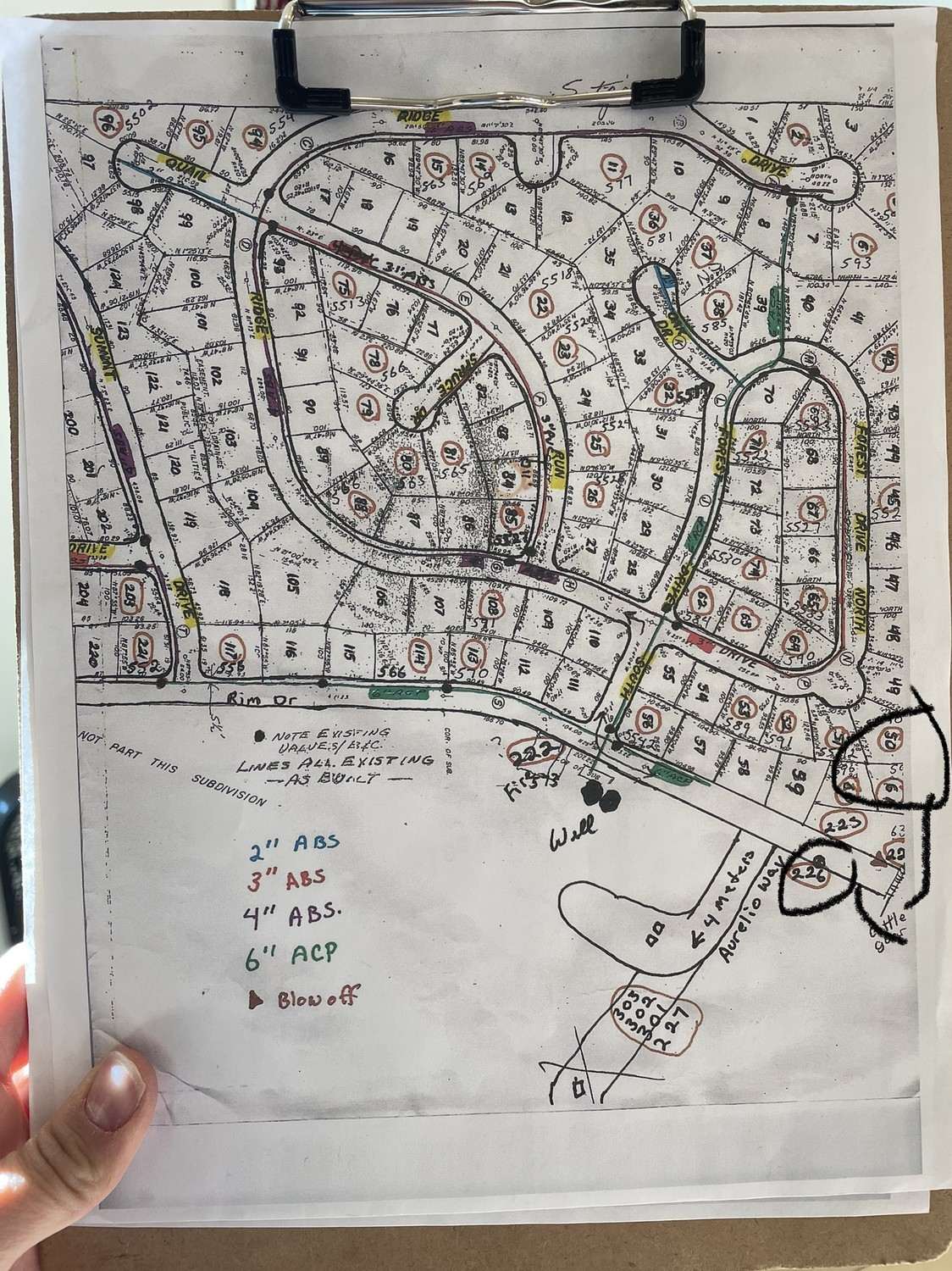
About 90 connections. Roughly 200 people, many of them retirees, many of the houses empty half the year. One well, and that well has more selenium in it than the law allows. Not because anyone spilled anything. It is simply what is in the rock underneath them.
What you cannot see from the road is the paperwork, and the paperwork is the story.
Why this took five years
The obvious question is why a district does not simply drill a new well.
Here is the actual sequence a system this size has to complete.
- 1
Test whether there is better water underneath you at all.
- 2
Find out the first site has four contaminants over the limit and that treating them is not realistic at this scale.
- 3
Go back to the state and ask to change the funded scope. Get a yes.
- 4
Negotiate with private landowners for a well parcel, a tank parcel uphill for gravity, and rights to an existing well held by three separate owners.
- 5
Design a main back to town. Secure a second loan, because the real project is twice the first.
- 6
Permit all of it.
What it would cost to treat instead
Selenium treatment does not end at the equipment. It produces a waste stream that has to be hauled away and disposed of, every year, forever.
For a system this size, roughly 90 connections, that is not a cheaper alternative to finding new water. It is a permanent bill nobody here could pay.
Mogollon Water Management's operator estimate, not a published engineering figure.
$19,238 per connection
That is the whole project divided by the number of connections. It is what this fix would have cost each household if Pinedale Estates had been required to pay for compliance out of its own rate base. Nobody here has that. Nobody here could borrow it either. That gap is the entire reason forgivable principal exists. Not generosity. Arithmetic.
About 90 connections serve about 180 parcels, most of them seasonal or undeveloped, which is why the figure is given per connection rather than per household. $1,731,384 divided by 90.
How Pinedale Estates got here, and how it gets out
The problem is thirty years old. The fix took five years, two loans and one change of plan.
What each loan funded
Two loans and one grant, nearly all of it money the district never has to repay.
| Loan | Year | What it funded | Forgivable share |
|---|---|---|---|
| 920324-21 / DW 037-2021 | 2021 | A pilot well, to establish whether usable groundwater existed before committing to a production well. | $550,000 of $750,000 |
| 920390-25 / DW 035-2025 | 2024 | The buildable system: new well facilities, the mainline back to the distribution system, storage, and rehabilitation of the acquired well. | All of $981,384, one hundred percent forgivable |
| WC7-364-2025, grant | 2025 | Ninety-two reporting meters across the district. | A grant of $40,000, nothing to repay |
Nearly all of the loan assistance is forgivable principal. The two loans total $1,731,384. Figures as of August 28, 2026, from WIFA's loan resolutions and executed loan documents and the WCGF award. How the fund behind these loans works, and where it stops, is on the Arizona funding page.
The meters are not a footnote
A $40,000 conservation grant put 92 reporting meters on this system.
Half these houses sit empty half the year. A toilet can run under a vacation home from October to April with nobody there to hear it.
"I keep a bottle of their water on my desk. Everybody who sees it assumes it is moonshine. It is their water."
Blake Anderson
who has operated the system since 2020
Where it stands
This is not finished.
The pumps are in, the main is in, the tank is going up, and final permitting and regulatory closeout are still ahead. What can be said is that a community of two hundred people, with no commercial base and no staff, is within sight of drinking water that meets the standard for the first time since anyone started checking. That happened because the funding was patient enough to survive the project changing shape twice.
The small-systems page explains why a district this size ends up here, and what does and does not fix it.
Who wrote this, and why it is on ziptility.com
Blake Anderson founded Mogollon Water Management, a water utility operator in Arizona. Under agreements with each district's elected board, Mogollon runs the day-to-day operation of the Heber DWID and Pinedale Estates DWID systems. Ziptility acquired Mogollon in April 2025; Mogollon runs as its own brand with its own team. Heber DWID uses Ziptility's software. Blake developed and teaches ADEQ's management training track for small-system boards and managers, holds Arizona's Grade 4 treatment and distribution certifications, and sits on WIFA's Federal Program Committee as a small-system representative. Nothing on this page speaks for WIFA or for either district; each district's own notices are on its own website. Every figure here is traceable to the sources below.
Sources
Every number on this page comes from one of these. Estimates are marked where they appear.
- District records: the well drilled in 1977, deepened in 1993, first documented over the limit in 1997; the district formed about 2019; $10,000 in the bank and five operators by 2020.
- WIFA loan resolutions and executed loan documents 920324-21 / DW 037-2021 and 920390-25 / DW 035-2025.
- 2022 scope change letter.
- 2024 project information letter, addenda and combined cost estimate.
- WIFA construction reports, April and July 2026.
- WCGF award WC7-364-2025.
- District operating data, August 2026 (current selenium concentration), and the district's selenium notice of August 19, 2026.
- Federal selenium MCL, 0.05 mg/L (40 CFR 141.62).
- Pinedale Estates DWID, the district's own website and notices.
- Per-connection figure: $1,731,384 divided by 90, the arithmetic on this page. Parcel count from district records.
- Treatment waste stream: Mogollon's operator estimate, no dollar figure published.
Corrections: blake@mogollonwater.com.
The sheet as handed out on August 28, 2026 is on the tour page with the other four. Where this page and the sheet differ, the page is current.